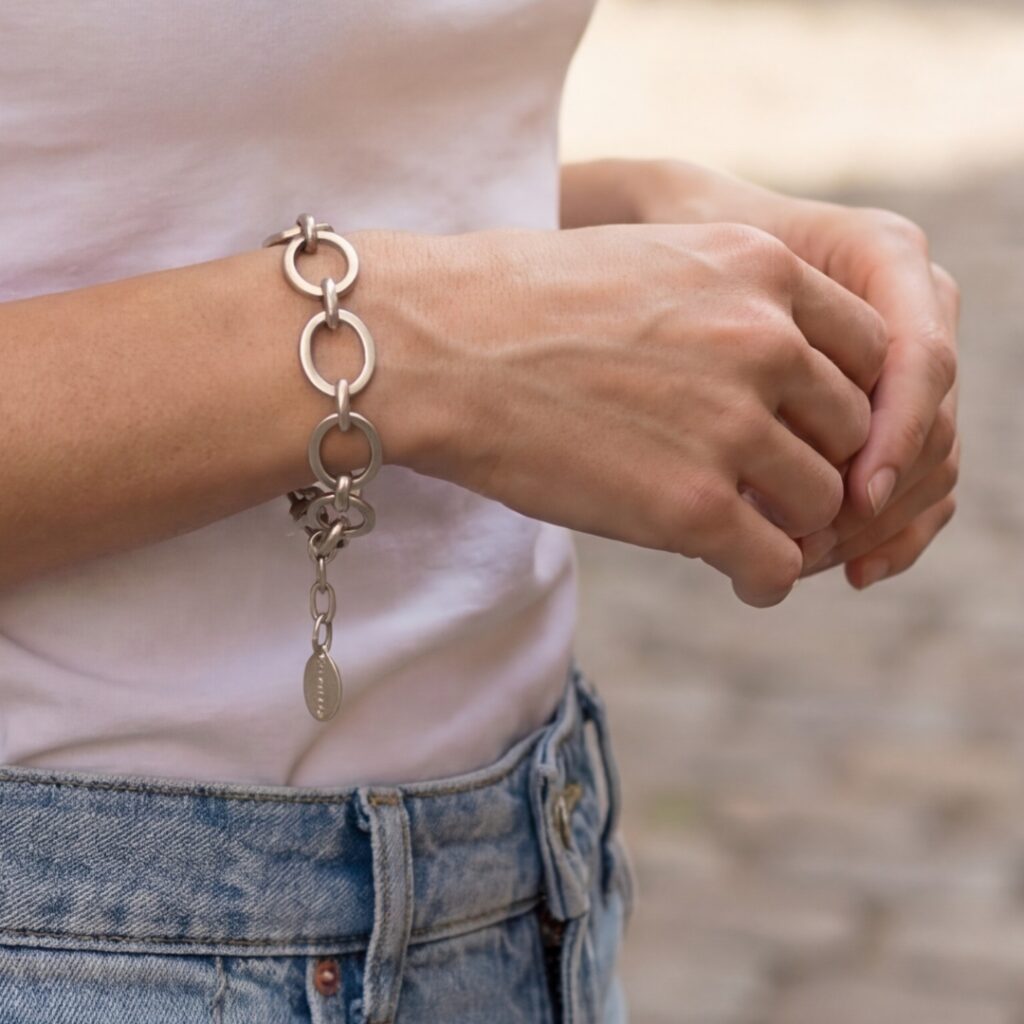
Bracelets – Bronze

Bronze bracelets

Bronze changed the history of jewelry

To create accessories, our ancestors used elements they found in nature, such as carved bones, seashells, small colored stones or wood.
The discovery of metals thousands of years ago changed the way jewelry was made. Artisans learned to master fire, and bronze became one of the most valued materials. Not only because it was strong and easy to shape, but also because of its warm, golden shine, similar to the sun, which immediately caught the attention of the leaders of the earliest civilizations.
From that moment on, bronze bracelets became increasingly popular, no longer seen as simple ornaments but as symbols of power, group identity and magic.
Over time, bronze bracelets travelled across the world, from one people to another, leaving their mark on different cultures and becoming an essential part of everyday life. Thanks to trade, many designs reached distant regions and went on to inspire other artisans.
Each region created its own designs, making every piece unique. Some bronze bracelets were simple and smooth, while others featured shapes, lines or small motifs engraved into the metal. Women and men wore bronze bracelets during celebrations, gatherings and ceremonies. In some cases, children would receive bracelets as a gift when they reached a certain age.

The great discovery of metal alloying

The craft of working with bronze was passed down from parents to children. Technical knowledge was shared within families, and each new generation learned from the one before.
Before bronze appeared, pure copper was used to create decorations and everyday objects. However, copper was too soft a metal, bending easily when struck or placed under pressure. For this reason, ancient metalworkers spent many years experimenting in their traditional furnaces with different mixtures of minerals extracted from the mountains.
Artisans discovered that by combining a large amount of copper with a small amount of tin, they could create a remarkable metal. Bronze was much stronger and harder than each of its components on its own. This new material also melted at a lower temperature, making it easier to work with and to pour into stone molds of different shapes.
Once the bronze had cooled, bronze bracelets were polished until they had a smooth surface. The color of newly polished bronze was also especially beautiful, shining with an intensity that recalled pure gold.

Bronze bracelets

Bronze changed the history of jewelry

To create accessories, our ancestors used elements they found in nature, such as carved bones, seashells, small colored stones or wood.
The discovery of metals thousands of years ago changed the way jewelry was made. Artisans learned to master fire, and bronze became one of the most valued materials. Not only because it was strong and easy to shape, but also because of its warm, golden shine, similar to the sun, which immediately caught the attention of the leaders of the earliest civilizations.
From that moment on, bronze bracelets became increasingly popular, no longer seen as simple ornaments but as symbols of power, group identity and magic.
Over time, bronze bracelets travelled across the world, from one people to another, leaving their mark on different cultures and becoming an essential part of everyday life. Thanks to trade, many designs reached distant regions and went on to inspire other artisans.
Each region created its own designs, making every piece unique. Some bronze bracelets were simple and smooth, while others featured shapes, lines or small motifs engraved into the metal. Women and men wore bronze bracelets during celebrations, gatherings and ceremonies. In some cases, children would receive bracelets as a gift when they reached a certain age.

The great discovery of metal alloying

The craft of working with bronze was passed down from parents to children. Technical knowledge was shared within families, and each new generation learned from the one before.
Before bronze appeared, pure copper was used to create decorations and everyday objects. However, copper was too soft a metal, bending easily when struck or placed under pressure. For this reason, ancient metalworkers spent many years experimenting in their traditional furnaces with different mixtures of minerals extracted from the mountains.
Artisans discovered that by combining a large amount of copper with a small amount of tin, they could create a remarkable metal. Bronze was much stronger and harder than each of its components on its own. This new material also melted at a lower temperature, making it easier to work with and to pour into stone molds of different shapes.
Once the bronze had cooled, bronze bracelets were polished until they had a smooth surface. The color of newly polished bronze was also especially beautiful, shining with an intensity that recalled pure gold.